Projects
Systems I have built, most significant first. Each one has a write-up covering how it works.
 HCA Healthcare
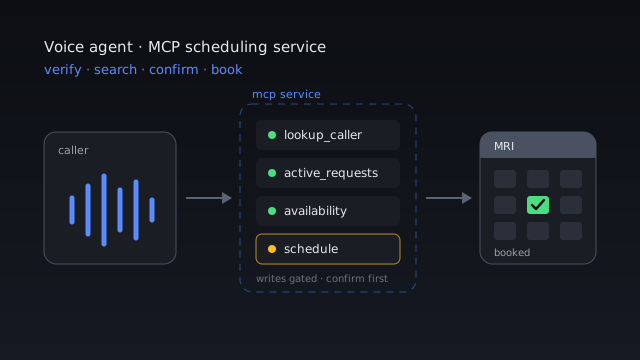
Voice Scheduling Agent over MCP
A proof of concept at HCA Healthcare: a voice agent that books imaging appointments by calling an MCP scheduling service I built, plus a dashboard for following each call.
3 to 5 minute calls · every completed demo call booked · offline mock backend
 HCA Healthcare
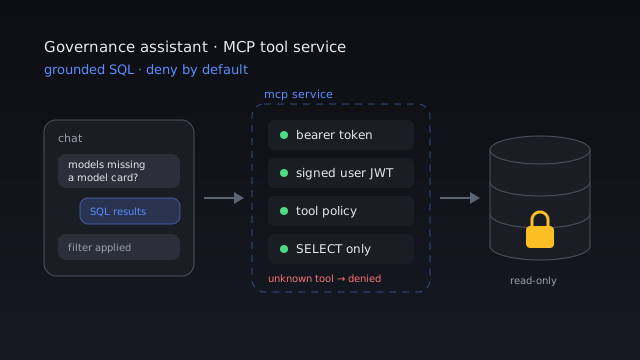
Data Governance Assistant over MCP
An LLM agent I added to a production governance web app at HCA Healthcare. It answers questions through grounded SQL over a secured MCP tool service and controls the dashboard from plain language.
Production web app · deny-by-default tool authorization · read-only SQL
 HCA Healthcare
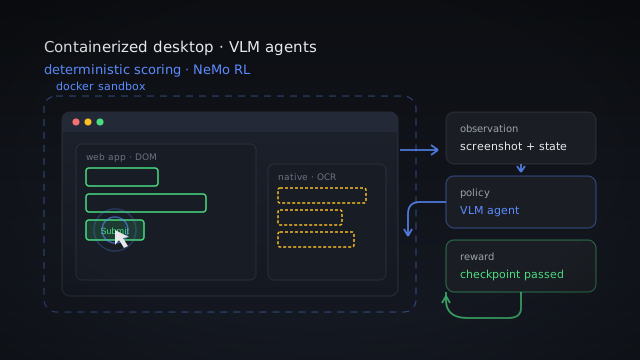
GUI Agent Benchmark and RL Environment
An internal platform at HCA Healthcare that containerizes a full Linux desktop to evaluate multimodal VLM agents on real enterprise workflows, later extended into a reinforcement learning training environment.
Containerized Linux desktop · deterministic checkpoint scoring · NeMo RL rollouts
 IEEE ISCAS 2025
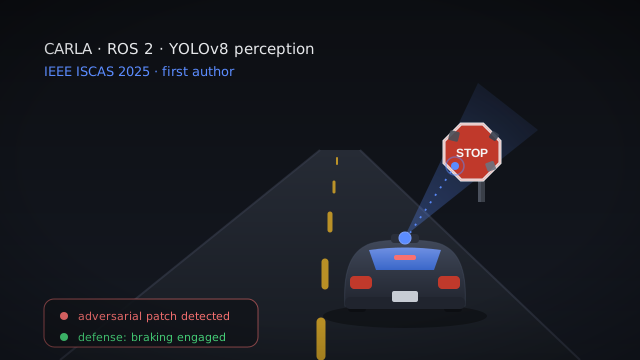
CARLA Adversarial Braking
Research code behind a first-author IEEE ISCAS 2025 paper on defending autonomous vehicles against camouflaged adversarial attacks, built on CARLA and ROS 2.
Attacked stop sign at 85 km/h · 10 m overshoot · two defenses restore safe stopping
 IEEE ICMLA 2025
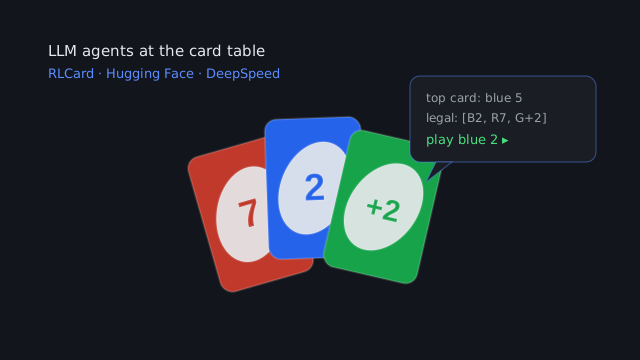
LLM UNO
An installable RLCard extension that lets decoder-only LLMs play UNO as agents, from single-GPU models to distributed 70B inference. Basis for a first-author IEEE ICMLA 2025 paper.
1B to 70B parameter models · up to 10,000 distributed games per configuration
 IEEE MILCOM 2025
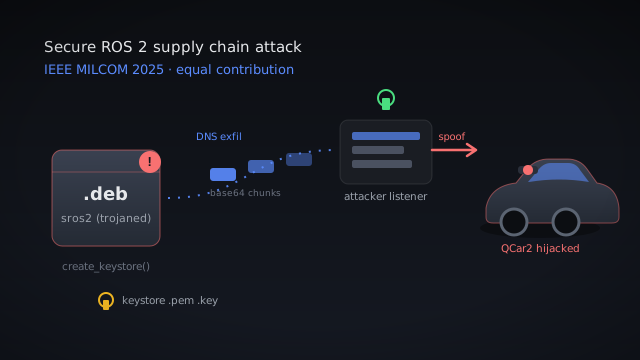
Supply Chain Exploitation of Secure ROS 2
A co-first-author IEEE MILCOM 2025 proof of concept: a trojanized Secure ROS 2 package that steals keystore credentials over DNS and hijacks a real autonomous vehicle.
Keystore exfiltration over DNS · 60 Hz spoofing on a physical Quanser QCar2
DCGAN on CelebA
Deep Convolutional GAN in TensorFlow trained on CelebA to generate realistic human face images.
View on GitHubSnake AI (Dyna-Q)
Classic Snake game implemented with the Dyna-Q reinforcement learning algorithm.
View on GitHubWW1 VR Experience
A Unity VR reconstruction of World War I battlefields built with a six-person team for Alvin C. York State Park, winner of the Distinguished Design Award.