LLM UNO
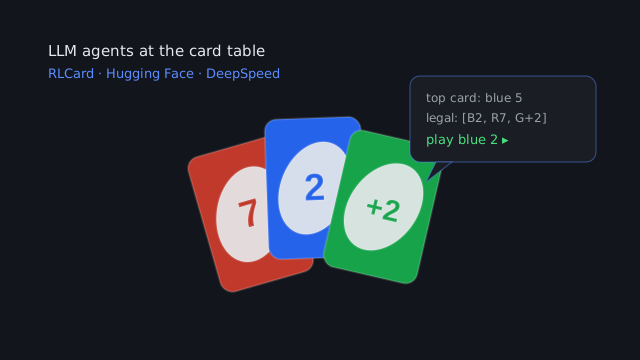
An installable RLCard extension that lets decoder-only LLMs play UNO as agents, from single-GPU models to distributed 70B inference. Basis for a first-author IEEE ICMLA 2025 paper.
Published research
LLMs as Agentic Cooperative Players in Multiplayer UNO
IEEE International Conference on Machine Learning and Applications (ICMLA) 2025
View on arXivWhat it is
A pip-installable Python package that extends RLCard, the card-game reinforcement learning toolkit, so decoder-only LLMs can play UNO as agents. It is the codebase behind my first-author ICMLA 2025 paper.
Most work on LLMs in games asks whether a model can win. This paper asks something different: whether an LLM can act as a non-player character that helps a different player win.
What the paper tested
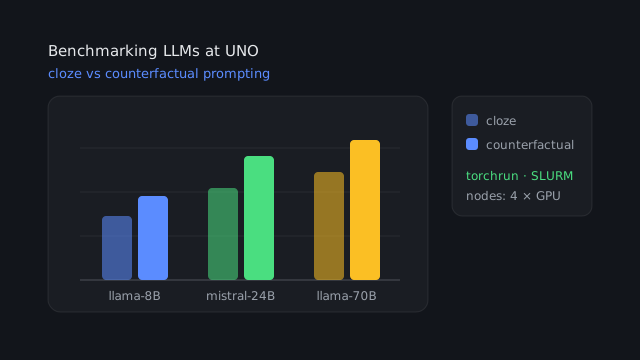
Two settings, across four models (LLaMA-3.2-1B, LLaMA-3.1-8B, Mistral-24B, LLaMA-3.3-70B), two prompting strategies, and 10,000 games per configuration.
Autonomous play. The LLM plays head to head against a random agent. Every model beat the random baseline with statistical significance under at least one prompting strategy. Mistral-24B was the best at 52.1% with cloze prompting, close to what RLCard’s trained DQN agent reaches, with no fine-tuning.
Cooperative play. The LLM takes a third seat and is told to help a rule-based teammate win instead of winning itself. Solo performance did not carry over. Against a 35.0% unassisted baseline, only LLaMA-3.3-70B with cloze prompting passed the significance threshold. The rest came close but did not clear it.
Engineering details
Correcting for token bias. Small models tend to pick whichever action is labeled “A” regardless of the game state, a base-rate effect rather than a real preference. The agent rotates the action-to-letter assignment across as many permutations as there are legal moves and sums the token probabilities, so the selected move reflects the cards instead of the label.
Two prompting strategies. Cloze prompting scores each legal action as a single-token completion. Counterfactual prompting asks whether a specific move is good or bad and takes the difference in probabilities. Cloze was more consistent across models.
Scaling to 70B. Small models run on one GPU. The 70B model needed DeepSpeed tensor parallelism across multiple GPU nodes under SLURM. That support is an optional [distributed] install extra so single-GPU users do not have to carry the dependencies.
Reproducing the results
The evaluation harness is in a companion repo, llm-uno-experiments, which is the reproducibility code cited in the paper. It holds the benchmark scripts, the per-model prompt templates for Llama 8B, Llama 70B, and Mistral 24B in both prompting variants, and the launch configs for running against local Hugging Face models, DeepSpeed-sharded models under torchrun and SLURM, or hosted models through OpenRouter.
Keeping it separate keeps llm-uno itself lightweight and installable while the experiments repo can accumulate cluster scripts and result logs.
What I took away
Pretrained LLMs play a structured game competently with no fine-tuning, but cooperative assistance is a separate capability and scale only partly buys it. Most of the engineering was in the interface: turning game state into prompts, and turning model output back into legal moves.